Penetrant inspection / crack detection
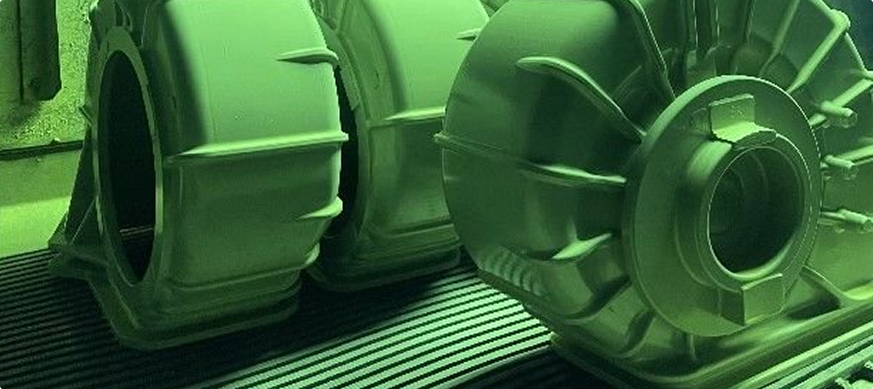
Penetrant Flaw Detection (PFD) is designed to identify any surface breaking defects such as cracks, laps or porosity. Our fully qualified Maycast-Nokes technicians are able to carry out complete surface inspection of castings and other metallic components.
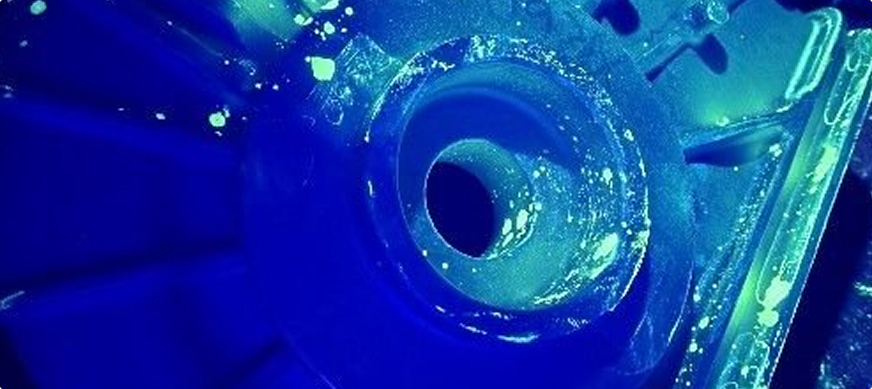
The principle of this testing method is that the dye/penetrant is drawn into any surface breaking defect by a process of capillary action. After a period of time soaking in the dye the castings are removed and rinsed. When viewed under ultra violet light any defect will ‘bleed’ with dye, indicating a possible defect. Castings are inspected against customer/national specifications and sentenced accordingly.
We employ multi-disciplined inspectors who are able to work in both NDT departments. All are qualified to NAS 410 / EN4179 + PCN level II. In addition to our Level II members of staff we also have an on-site Level III, who is qualified to write and sanction of our own process techniques without any assistance from an external source.
Both departments are fully Nadcap approved and are currently on the PRI Merit program (24 month audits) following eight previous successful audits.
Sub-contract testing service
In addition to carrying out NDT inspections of our own castings Maycast-Nokes also offers a sub-contract NDT service, inspecting components manufactured by other companies to their required standards – please contact Tony Mays (tmays@maycast.co.uk) for further information.
Penetrant inspection frequently asked questions
Questions about penetrant inspection and crack detection, supporting quality assurance for critical cast components.
-
Penetrant Flaw Detection (PFD), also known as Dye Penetrant Inspection (DPI) or Liquid Penetrant Inspection (LPI) or Fluorescent Penetrant Inspection (FPI) is a non-destructive testing method used to find surface-breaking defects like cracks and porosity in non-porous materials such as Aluminium. It works via capillary action, where a fluorescent liquid penetrant is drawn into flaws, then later revealed using a developer. The developer acts like a blotter, drawing the trapped penetrant out of the flaws (“bleed-out”) and making the defects clearly visible under UV light.
In Aluminium castings, PFD is essential for evaluating part integrity because casting processes can easily introduce microscopic surface defects.
-
PFD has its Limitations. It can only detect flaws that break through to the surface of the Aluminium. It cannot detect internal, subsurface porosity. Highly porous, cast surfaces can sometimes trap penetrant, causing “false indications”. Castings typically require machining before testing for high-sensitivity requirements such as sealing faces or ‘O’ Ring grooves.
-
PFD is a highly effective and cost‑efficient Non‑Destructive Testing (NDT) method designed to reveal surface‑breaking defects on a casting. It’s ideal for quickly identifying issues that the naked eye would miss — such as hairline cracks, fine porosity, cold shuts or through defects on thin walled castings – ensuring your components meet the required quality standards before moving forward.
One of the biggest advantages of PFD is its versatility. It works on almost all non‑porous materials, including both ferrous and non‑ferrous metals, and can be carried out easily directly on-site. With minimal equipment and low operating costs, it offers excellent value without compromising accuracy.
Like any inspection method, PFD has its limits. Because it only detects defects that reach the surface, it cannot identify deeper internal issues such as hidden gas porosity or internal shrinkage. It also relies on proper surface preparation — the casting must be thoroughly cleaned to ensure contaminants don’t mask potential flaws.
For components that require inspection beyond the surface, we recommend complementary NDT methods. Radiographic Testing (X‑Ray) is ideal for detecting deep internal defects, while Magnetic Particle Inspection (MPI) is better suited for locating just‑below‑surface flaws in ferrous materials.
-
Our NADCAP-approved Penetrant Flaw Detection (PFD) facility, the inspection results must be recorded in a controlled and traceable manner that complies with customer specifications, Nadcap requirements, and the applicable standards such as AMS 2644, ASTM E1417, EN4179, NAS410, or customer-specific procedures.
Typical inspection records include:
Job Identification; Process Parameters; Inspection Results; Defect Mapping; Inspection Disposition (Accept/reject/rework/concession); Personnel Traceability; Equipment Traceability; Retention of Records (In aerospace foundries and machine shops, retention periods of 7–30 years are common depending on the customer and end application).
-
Non-Destructive Testing (NDT): Maycast-Nokes provides fully accredited Non-Destructive Testing (NDT) services, on-site here in Halstead. This includes Radiographic Testing (X-Ray) and Liquid Penetrant Inspection (LPI), to verify the integrity and quality of castings and precision-engineered components.
Penetrant Flaw Detection (PFD) – Expertise and Certification: Our NDT personnel are certified to NAS 410, EN4179, and PCN Level II standards and are trained to operate across multiple inspection disciplines. The team is supported by an in-house Level III specialist, providing complete control over procedure development, qualification, and technical oversight.
Both our Radiographic Testing and Liquid Penetrant Inspection facilities are fully Nadcap accredited. Reflecting our ongoing commitment to quality, compliance, and continuous improvement.
In addition to supporting our own manufacturing operations, Maycast-Nokes offers independent subcontract NDT inspection services for externally manufactured components. Inspections can be performed to customer-specific requirements, aerospace standards, and other applicable industry specifications.
For further information about our NDT capabilities or subcontract inspection services, please contact our team.
Explore more of our services
-

Quality assurance
Read more about how we maintain quality control and inspection procedures.
Learn more -

Meet the team
Learn more about the people behind Maycast Nokes and the roles they lead.
View our team