Investment / lost wax casting
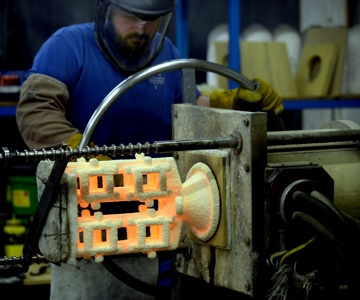
Precision investment castings enable the production of components that offer a high level of accuracy, integrity and reliability, whilst reducing the need for expensive secondary machining.
Using the latest in materials technology, complex internal features can be achieved using sacrificial wax or ceramic cores. Steel inserts within an aluminium alloy casting offer the designer the elevated mechanical properties of steel in localised areas but without the weight penalties.
Typical applications for precision investment castings include Aerospace, Automotive, Communications and Motorsport.
Investment / lost wax frequently asked questions
Common questions about investment (lost wax) casting, including accuracy, surface finish and how we support complex aluminium components.
-
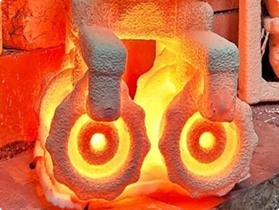
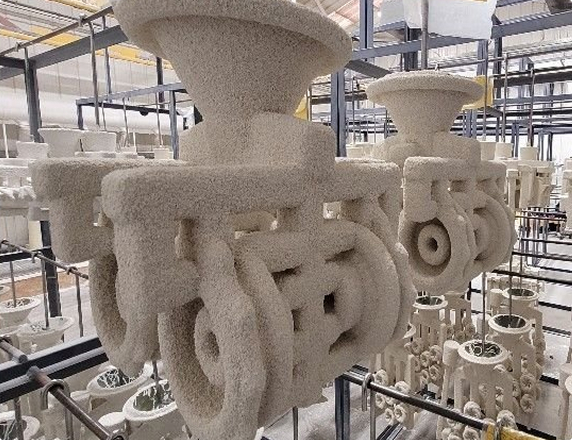
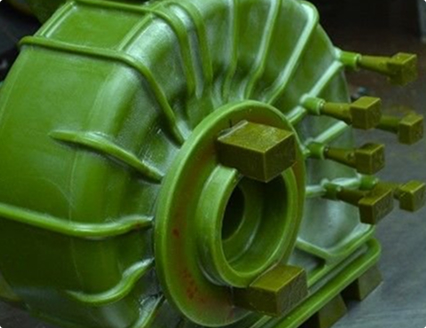
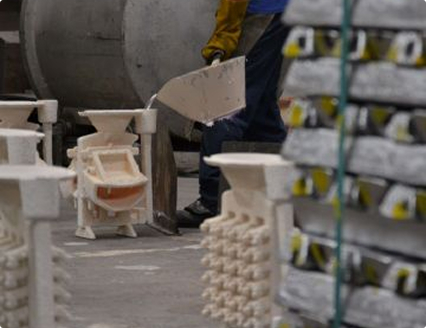
Investment casting, or ‘lost‑wax’ casting, is a process that lets you create very detailed metal parts. A wax model of the part is made first, which is then covered in multiple layers of ceramic shell to form the mould. The wax is removed in a steam autoclave, creating an exact cavity; molten metal takes its place, creating the final piece. It’s especially useful when you need complex shapes, thin wall sections and a fine cast surface finish.
-
Investment casting is often the ideal choice when a component requires high precision, fine detail, or complex geometry that other casting processes struggle to achieve. While Sand Casting and Gravity Die Casting each have their strengths, Investment Casting stands out when accuracy, thin-walled sections and intricacy are key.
Investment casting is suitable for a wide range of alloys, including those that are difficult to cast using other methods. Investment casting tooling costs are higher than Sand Casting but lower than Gravity Die, making it ideal for moderate batch sizes.
-
Investment Casting excels when a part requires high dimensional accuracy and complex internal or external features. The process delivers an exceptionally precise as‑cast form, meaning the finished component typically needs only minimal machining. It also provides a premium surface finish and is ideal for lightweight or thin‑section designs where detail and consistency are essential.
-
Yes – we work with a highly skilled pool of toolmakers who regularly support us in manufacturing new tooling and carrying out modifications to existing tools. We are also open to discussing the transfer of tools to our facility; however, some adjustments may still be required to ensure compatibility with our wax injection machines.
An investment casting tool is much like a three-dimensional puzzle. Its design and manufacture can be incredibly intricate, especially within the core areas. In operation, more complex tools may take several hours to dismantle and rebuild, which naturally limits wax output.
-
Yes – Alongside producing high‑quality aluminium castings, we also offer full machining and finishing — giving you a complete, production-ready component from a single supplier.
However, one important factor in this process is machinability: how easily a material can be cut and shaped to achieve an accurate part.
While aluminium is generally very machinable, different alloys behave differently. Some machine quickly and cleanly, while others require slower cutting speeds or more robust tooling. That’s why alloy selection plays a key role in achieving the best machining performance, lead times, and final surface quality.
By managing the complete process, from casting to machining, we help you choose the right alloy from the start, ensuring efficiency, consistency, and a high‑quality finished part.
Explore more of our services
-

Quality assurance
Read more about how we maintain quality control and inspection procedures.
Learn more -

Meet the team
Learn more about the people behind Maycast Nokes and the roles they lead.
View our team