Fine precision sand casting
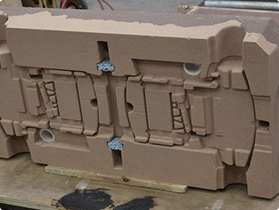
Boxless / Block moulding
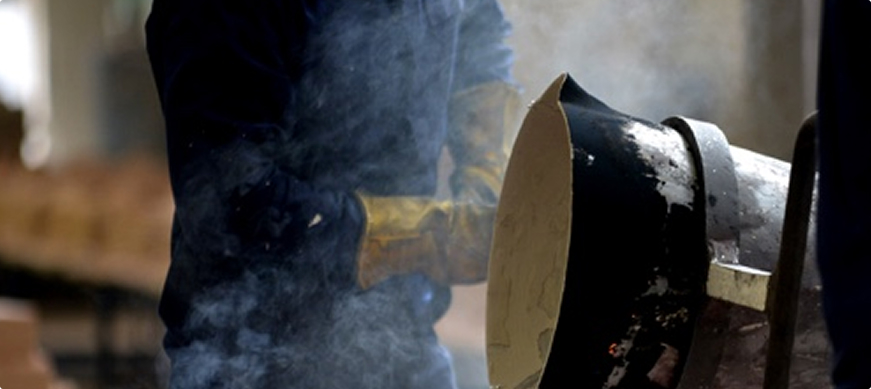
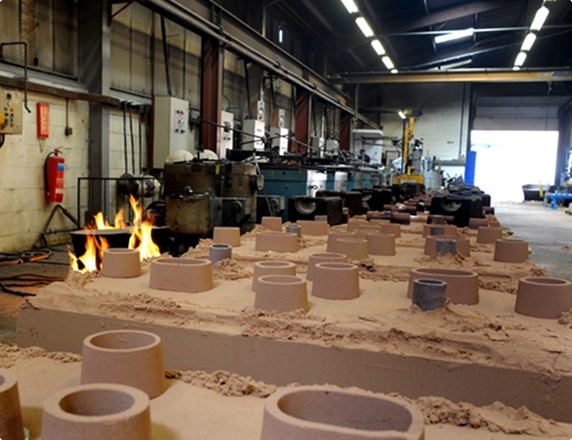
Boxless/Block moulding is used for the production of sand castings weighing from of 0.1kg up to 30kg. Often, multi-impression pattern equipment can be used, meaning that this technique can be highly cost effective whilst giving an excellent surface finish. Using either wood or resin pattern equipment, this method offers excellent repeatability whilst achieving extremely tight tolerances. This can result in the reduction of costly machining operations.
Floor moulding
Floor moulding activities are carried out by highly experienced, skilled craftsmen and can be used to either make sand castings from inexpensive loose pattern equipment (ideal for prototypes) or very large parts which are too big for the block casting.
Sand casting frequently asked questions
Common questions about our fine precision sand casting capabilities and tolerances, answered.
-
Precision sand casting is a manufacturing process used to produce complex aluminium components by pouring molten aluminium into a highly accurate sand mould. The process enables the creation of intricate geometries while maintaining excellent structural integrity and consistent repeatability. At Maycast Nokes, precision sand casting is used for both prototype and production components, with rigorous quality control measures implemented throughout the manufacturing process.
-
Every component is unique. Lead-times are dependent on many factors, such as production capacity, pattern/tooling design and manufacture, post processing operations, finishing, sub-contract availability and the complexity of each part.
Component lead-time is calculated by taking all of these inputs into account, and can be separated into two stages: Tooling (Initial) Lead Time and Production Lead Time.
-
There is a complete table of sand casting tolerances in the Quality section – this includes linear dimensions, wall thickness and surface finish.
-
Yes – Alongside producing high‑quality aluminium castings, we also offer full machining and finishing — giving you a complete, production-ready component from a single supplier.
However, one important factor in this process is machinability: how easily a material can be cut and shaped to achieve an accurate part.
While aluminium is generally very machinable, different alloys behave differently. Some machine quickly and cleanly, while others require slower cutting speeds or more robust tooling. That’s why alloy selection plays a key role in achieving the best machining performance, lead times, and final surface quality.
By managing the complete process, from casting to machining, we help you choose the right alloy from the start, ensuring efficiency, consistency, and a high‑quality finished part.
-
Quality assurance is integral to every stage of our operation. We utilise advanced inspection technology, including CNC coordinate measurement systems and laser profile scanning, to maintain precise manufacturing standards. We hold both ISO 9001:2015 & AS9100, along with NADCAP, a globally recognised, industry-managed accreditation system for the aviation, defence, and space sectors.
Our fully integrated production and management systems allow us to deliver efficient, reliable solutions that support both lean manufacturing practices and customer-specific quality requirements.
-
We predominantly produce castings in aluminium alloys; however, we also regularly manufacture investment castings in stainless steel and other steel alloys. Material selection is largely determined by the required physical and mechanical properties, together with the inherent casting characteristics of each alloy.
Research is key, we provide several downloads on this website that inform the decision-making process. We encourage you to contact us to discuss your application in detail, enabling us to fully understand your requirements and recommend the most suitable solution.
Explore more of our services
-

Quality assurance
Read more about how we maintain quality control and inspection procedures.
Learn more -

Meet the team
Learn more about the people behind Maycast Nokes and the roles they lead.
View our team